Connect with us

Blogs

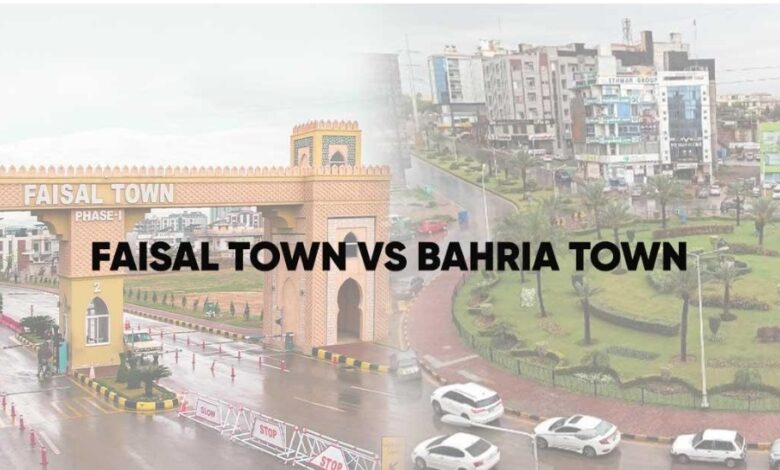
Faisal Town vs Bahria Town Islamabad: Which Housing Society Offers Better Value in 2025?

Published

on

Islamabad’s ever-evolving real estate landscape presents a diverse range of promising investment opportunities, luxury lifestyle communities, and reliable, developer-backed housing societies. Among the top contenders in the capital region are Faisal Town and Bahria Town Islamabad. While both have earned reputations for quality and innovation, they cater to distinct buyer needs and offer different value propositions. 

This article presents an in-depth comparison of Faisal Town and Bahria Town, guiding you through essential criteria such as location, legal status, pricing, infrastructure, and long-term prospects. 

Original Credits Goes to: Faisal Town Islamabad | Location | Payment Plan | NOC 2025

  1. Location and Accessibility

Faisal Town, Islamabad, is situated near the Tarnol Interchange on the M-1 Motorway, directly along Fateh Jang Road. This strategic positioning places it within a 10-minute drive of the New Islamabad International Airport. The society benefits from direct connectivity to the twin cities via the M-1 and N-80 highways and lies near G-13, G-14, and the Kashmir Highway. This makes it a highly attractive choice for professionals, frequent travellers, and businesses requiring swift inter-city mobility.

On the other hand, Bahria Town Islamabad is spread across multiple phases and sectors, situated along the main GT Road and the Islamabad Expressway.While its location is comparatively farther from central Islamabad than Faisal Town, it still maintains excellent connectivity via wide road networks and internal transport systems.the Bahria Enclave project, part of the larger Bahria Town brand, is situated closer to central Islamabad but offers more limited accessibility options than its main phases.

  1. Legal Status and Developer Reputation

Faisal Town is developed by Zedem International Pvt. Ltd., under the leadership of Chaudhry Abdul Majeed. The company has a robust reputation for delivering large-scale projects such as Faisal Margalla City and the increasingly popular Faisal Hills Islamabad. The legal status of Faisal Town is well-documented, with approvals and NOC clearance from the Rawalpindi Development Authority (RDA). Zedem International’s successful track record and transparent dealings have built considerable trust among investors.

Bahria Town, spearheaded by Malik Riaz Hussain, is one of Pakistan’s most well-known and controversial real estate developers. Bahria Town Islamabad, though renowned for its innovative urban planning and amenities, has faced legal scrutiny in the past regarding land acquisition and NOC regularizations. That said, the brand continues to command respect for its infrastructure quality, luxury orientation, and massive scale.

  1. Plot Sizes and Pricing

Faisal Town Islamabad offers a variety of residential plot sizes, including 5 Marla, 8 Marla, 10 Marla, 14 Marla, and 1 Kanal. Prices range from PKR 55 lakh for smaller plots to PKR 2 crore for larger, prime-location plots. These are primarily resale rates, as most plots were sold out in initial launches. The relatively reasonable pricing compared to central Islamabad and the fast pace of development make Faisal Town a value-for-money option.

Bahria Town Islamabad offers a broader range of plot options in terms of availability and pricing. From compact 5 Marla plots to expansive 2 Kanal estates, Bahria accommodates all budget ranges. Prices in Bahria Town tend to start higher, with 5 Marla plots in popular sectors priced upwards of PKR 70–90 lakh, depending on location. Premium phases and commercial areas can go well into crores, especially in Phase 8 or Bahria Enclave.

  1. Payment Plans

Faisal Town initially offered attractive payment plans for early investors, typically requiring a 20–30% down payment with installments over three to four years.While most of the plots are now available through resale, new block extensions, such as Block B1, have reintroduced installment-based purchases, offering buyers a more flexible entry point.

Bahria Town Islamabad generally does not offer traditional installment plans for ready plots, particularly in its mature sectors. However, when launching new sectors or apartments, limited installment options do become available. The typical model relies heavily on upfront payments and investor liquidity, which may be a barrier for first-time buyers.

  1. Development Status

Faisal Town has made remarkable development progress in a relatively short time. Blocks A and B are fully developed, featuring utilities, roads, parks, and residential structures. Block C is undergoing fast-paced construction, and Block B1 has seen renewed interest due to its installment offerings. The presence of residents, functioning schools, and commercial units underscores Faisal Town’s livability.

Bahria Town Islamabad boasts one of the most expansive real estate footprints in the country. Many of its phases are fully developed and densely populated, complete with top-tier infrastructure and lifestyle facilities. However, some newer phases and portions of Bahria Enclave are still under development, and the pace can be slower than expected due to the sheer size of the undertaking.

  1. Amenities and Infrastructure

Faisal Town Islamabad offers a modern gated community with 24/7 security, underground utilities, carpeted roads, parks, mosques, and educational institutions. Commercial areas are well-planne and experiencing rapid growth. The infrastructure quality has consistently been praised, especially considering the comparatively lower investment threshold.

Bahria Town, as a luxury-oriented brand, goes a step further by offering private hospitals, elite schools, grand mosques, mega malls, theme parks, and even zoos.Its iconic replicas of international landmarks, such as the Eiffel Tower and Trafalgar Square, are part of its effort to create a self-contained, world-class city. However, these luxuries come with a higher price tag.

  1. Investment Potential

Faisal Town has demonstrated steady and sustainable growth since its inception. The proximity to Islamabad Airport, the M-1 corridor, and the surge in demand from surrounding projects, such as Faisal Hills Islamabad, has led to a rise in property values. Investors who entered during the early phases have already seen strong returns, and new developments, such as Block B1, continue to offer upside potential.

Bahria Town’s investment potential remains robust, particularly in premium sectors. Its long-standing brand presence ensures demand, especially for rental income and commercial ventures. However, rapid price fluctuations and legal entanglements can sometimes affect investor confidence. Long-term holding is generally more beneficial in Bahria Town compare to short flips.

  1. Buyer Profile and Target Audience

Faisal Town, Islamabad, attracts middle-income families, salaried professionals, and mid-range investors who seek a quality living at affordable prices. Its installment options and accessible pricing also make it a popular choice among first-time homeowners and overseas Pakistanis returning with modest budgets.

Bahria Town typically appeals to upper-middle-class and elite buyers who prioritize lifestyle over budget constraints. It also draws attention from overseas Pakistanis looking for brand association and luxury accommodations. Due to its high rental potential, many investors opt for Bahria Town as a means of generating passive income through furnished apartments and villas.

  1. Long-Term Growth and Infrastructure Outlook

The long-term outlook for Faisal Town Islamabad is optimistic, thanks to its strategic location and the growing influence of Zedem International in the region. The success of Faisal Hills, situated near the GT Road and the CPEC Western Route, further solidifies confidence in the developer’s ability to deliver high-quality, fast-paced projects. Faisal Hills itself is becoming a mini metropolis, with rapid infrastructure deployment, multiple sectors under development, and a growing population. This ripple effect benefits Faisal Town, elevating its profile within the Islamabad real estate ecosystem.

Bahria Town’s long-term growth hinges on continued development and urban sprawl. As Islamaba expands outward, Bahria’s later phases are expected to integrate more tightly with the city. However, its growth may be slowe by bureaucratic hurdles or oversupply in specific sectors.

  1. Community Life and Urban Planning

Faisal Town Islamabad provides a peaceful, family-centric environment with a strong sense of community. Its moderate density, well-planned sectors, and easy access to public amenities make it an ideal choice for those seeking a balanced urban-suburban lifestyle

The urban planning reflects an emphasis on green spaces, utility accessibility, and residential convenience.

Bahria Town’s urban planning is among the most sophisticated in Pakistan. Each sector functions as a self-contained city, with road networks, commercial plazas, educational institutions, and healthcare facilities integrated into its layout. However, this scale can sometimes make it feel less cohesive and more commercialized than communities like Faisal Town or Faisal Hills.

  1. Risks and Considerations

While Faisal Town Islamabad enjoys strong developer credibility and RDA approval, its proximity to rapidly expanding neighboring societies means it faces stiff competition. Future saturation may impact price appreciation if new sectors aren’t introduce or upgraded regularly.

Bahria Town’s primary risk lies in its legal history. Court cases and regulatory issues have occasionally caused buyer hesitation. Moreover, some investors have faced delays in possession, particularly in areas such as Bahria Enclave or recently launched sectors. Despite its glamour, due diligence is essential before committing capital.

Final Verdict

In the Faisal Town vs Bahria Town debate, there’s no one-size-fits-all answer. Faisal Town Islamabad offers practicality, affordability, and solid development credentials. Its proximity to key transport hubs and growing demand in adjacent projects, such as Faisal Hills Islamabad, makes it a well-rounded choice for families and investors alike.

For those seeking immediate possession, community living, and a proven track record of delivery, Faisal Town is a compelling option. For buyers with a higher budget, a taste for luxury, and a long-term investment mindset, Bahria Town continues to deliver value in a competitive market.

In either case, Islamabad’s real estate scene remains vibrant—and both Faisal Town and Bahria Town are excellent gateways into the capital’s property market.

Continue Reading
Click to comment

Leave a Reply

Your email address will not be published. Required fields are marked *

Blogs

Britain’s new Islamophobia czar has ignited a national debate 

Published

on

Britain’s new Islamophobia czar has ignited a national debate 

The UK government’s decision to appoint an adviser dedicated to tackling Islamophobia has triggered a broad national debate. Supporters describe the move as a necessary response to rising anti-Muslim hostility. Critics see it as an unnecessary and potentially dangerous expansion of government authority.

The role, sometimes referred to in political commentary as an “Islamophobia czar”, forms part of a wider strategy to address discrimination and social cohesion. It accompanies efforts to develop an official definition of anti-Muslim hostility and to improve how institutions respond to hate crimes and discrimination. 

The appointment reflects a growing political recognition that prejudice against Muslims remains a persistent problem in Britain. Yet the debate surrounding the role reveals deeper disagreements about free speech, identity politics and the role of the state.

As with many contemporary issues in British public life, the controversy reflects a country grappling with competing priorities.

Why the government believes the role is necessary

Supporters of the appointment argue that the role fills an important gap in Britain’s approach to discrimination.

Recorded religious hate crimes against Muslims have risen significantly over the past decade. For many campaigners and community organisations, this trend highlights the need for stronger institutional responses. 

The government’s new strategy aims to provide clearer guidance on what constitutes anti-Muslim hostility. Officials argue that defining the problem makes it easier to measure, prevent and respond to it. 

An adviser or “czar” would help coordinate efforts across government departments, police forces and public institutions. The role is expected to monitor trends in anti-Muslim hatred, recommend policy responses and engage with community groups.

For many British Muslims, the appointment signals that the government is taking their concerns seriously. Some community organisations have argued that formal recognition of anti-Muslim hostility is long overdue. 

Supporters also point out that similar roles already exist in Britain. The government previously appointed advisers focused on tackling antisemitism and extremism. The new role is often framed as part of a broader effort to ensure equal protection for all religious groups.

From this perspective, the appointment is not an extraordinary step. Instead it represents an attempt to bring policy on anti-Muslim prejudice into line with existing approaches to other forms of discrimination.

The argument from critics

Despite these arguments, the proposal has faced strong criticism from some politicians, commentators and civil liberties advocates.

One of the central concerns relates to freedom of expression. Critics argue that defining Islamophobia too broadly could discourage legitimate criticism of religion or political ideology.

Some legal experts have warned that an official definition could blur the line between hate speech and legitimate debate. Concerns have been raised that such policies might unintentionally restrict discussions about extremism, religion or cultural practices. 

Others worry about the symbolic implications of appointing a government “czar” focused on a particular religious community. They argue that this could create the perception that one group is receiving special treatment.

As of 2025, the Muslim population in the United Kingdom was estimated at around four million people. The population increased from 2.7 million in 2011 to around 3.9 million in 2021 and continues to grow. Muslims in the UK are the second-largest religious group in the UK after Christians – representing a significant voting force in British society. 

Some critics of the position believe that a government role focused solely on pro-Muslim issues will stifle free speech on hot-button topics including Iran and Gaza. Others believe it will downplay crimes committed by Muslim-majority communities including the infamous grooming gangs

For critics on the political right, the proposal also reflects broader concerns about identity politics. They argue that government policy should focus on universal principles of equality rather than targeted initiatives for specific communities.

In this view, existing laws against discrimination and hate crimes are already sufficient. The appointment of a dedicated adviser is therefore seen as unnecessary.

The debate over definitions

At the heart of the controversy lies a deceptively simple question: how should Islamophobia be defined?

The government has increasingly used the phrase “anti-Muslim hostility” rather than Islamophobia in official policy discussions. This wording is intended to focus on discrimination directed at people rather than criticism of religious beliefs. 

Yet the shift in terminology has itself become controversial. Some campaign groups argue that abandoning the term Islamophobia weakens efforts to address the problem. Others believe the new language provides a clearer and more precise definition.

Definitions matter because they shape how institutions respond to discrimination. Police forces, universities and local authorities rely on clear terminology when investigating complaints or implementing policies.

The challenge lies in balancing two competing concerns. On one side is the need to protect individuals from discrimination and harassment. On the other is the importance of safeguarding free debate in a democratic society.

This tension sits at the centre of the public debate.

Public opinion: cautious support mixed with scepticism

Public reaction to the appointment reflects the broader complexity of the issue.

Many Britons support stronger measures to combat religious hatred. Surveys and community studies consistently show that the public believes discrimination against religious minorities is unacceptable.

At the same time, there is widespread concern about freedom of speech. The UK has experienced several contentious debates in recent years involving religion, satire and cultural criticism.

These tensions shape how the public views the proposed role.

For some voters, the appointment signals an effort to protect vulnerable communities and strengthen social cohesion. For others, it raises concerns about government intervention in cultural debates.

The divide does not always follow traditional political lines. Support and criticism can be found across the political spectrum.

Some progressive commentators emphasise the importance of addressing discrimination against British Muslims. Meanwhile others within the same political space worry about unintended consequences for open debate.

Similarly, critics of the policy are not limited to conservative voices. Some secular activists and civil liberties groups share concerns about the potential impact on free speech.

The broader political context

The debate surrounding the Islamophobia adviser also reflects broader trends in British politics.

Issues of identity, integration and multiculturalism have become increasingly prominent over the past two decades. Events ranging from terrorist attacks to international conflicts have shaped public perceptions and political discourse.

These developments have influenced how governments approach questions of discrimination and social cohesion.

At the same time, Britain remains a diverse society with a long tradition of religious freedom. Around four million Muslims live in the UK, representing a wide range of ethnic, cultural and political backgrounds.

Policy responses therefore operate within a complex social environment.

Efforts to combat prejudice must address genuine experiences of discrimination. Yet they must also navigate concerns about civil liberties and political neutrality.

The creation of a new advisory role reflects the difficulty of balancing these priorities.

Lessons from past initiatives

The UK has experimented with similar roles in the past. Governments have appointed advisers to address antisemitism, extremism and other forms of discrimination.

These positions often serve as bridges between communities and policymakers. They provide expertise and help coordinate responses across government departments.

However, such roles also attract scrutiny. Questions about independence, political influence and effectiveness frequently arise.

The new Islamophobia adviser will likely face similar challenges. The success of the role may depend less on its symbolic value and more on its practical impact.

Effective policy requires credible data, transparent processes and cooperation across institutions.

Without these elements, even well-intentioned initiatives can struggle to produce meaningful change.

A debate that reflects Britain’s changing society

The argument over the Islamophobia adviser reveals something deeper about contemporary Britain.

The country is increasingly diverse and politically complex. Issues that once existed on the margins of political debate now sit at its centre.

Questions about identity, discrimination and free speech are no longer confined to academic discussions. They shape national politics and public discourse.

The appointment of an adviser to tackle anti-Muslim hostility therefore represents more than a single policy decision. It reflects a wider conversation about how Britain understands itself as a society.

For supporters, the role is a sign that the state is willing to confront prejudice and protect minorities. For critics, it raises difficult questions about the limits of government authority and the preservation of open debate.

Both perspectives capture genuine concerns. The challenge for policymakers lies in finding a balance between them.

The challenge ahead

As the new adviser begins their work, expectations will be high.

Supporters will hope the role leads to tangible progress in tackling discrimination. Critics will watch closely for signs that the position expands government influence over cultural debates.

The future of the initiative may depend on whether it can demonstrate practical value without deepening political divisions.

Britain has long prided itself on its commitment to tolerance and free expression. Maintaining both principles in a rapidly changing society remains one of the central challenges of modern politics.

The debate over the Islamophobia czar shows just how complicated that task has become.

Continue Reading

Blogs

Hope Park Martyrs Church: A Dark spiritual and historic treasure of St Andrews

Published

on

Hope Park Martyrs Church: A Dark spiritual and historic treasure of St Andrews

One of the most notable worship places in the old town of St Andrews in Scotland is Hope park Martyrs church. The church community is very friendly and the church itself has a rich history and therefore; it has a representation both of the spiritual tradition of the community and the tradition of the Scottish Reformation. Hope Park Martyrs Church is a church that is situated in the town with a rich cultural background and is still used as a place of worship, memorial, and socialization.

The St Andrews historicity

St. Andrews is a place that is associated with golf history and ancient university. It is also referred to as the Home of Golf and the visitors worldwide come to golf at the famous Old Course as well as the long-standing traditions of the game. The University of St Andrews, which is one of the oldest English-speaking university is located in St Andrews and over the centuries it has played a significant role in the intellectual and cultural life of the town. Besides these attractions of interest, the town is also deep in religious heritage that is presented in its old churches, ruins of cathedrals and its places of worship.

History and Development of Hope Park Martyrs Church

The hope park martyrs church occurred due to the merger between the Hope Park Church and the St Andrews martyrs church. Both were well-established and old members of the Church of Scotland and both serve the community of the locality in worship, outreach and pastoral care. Their union brought together the many generations old traditions and created one flock that adheres to the ideals of faith, service and community.

Martyrs in church refers to the protestant reformists, who were burned in St Andrews in the 16 th century following their religious positions. These were great personalities of the Reformation history of Scotland, and their martyrdom became a powerful symbol of religious faith and heroism. By honouring these martyrs in its name the church takes care of an important part of the spiritual heritage of the town.

Architecture and Location

The Hope Park Martyrs Church is located in the heart of St Andrews as far as the old streets and land marks which form the featuring characteristics of the town are involved. The ecclesiastical planning of the church building is the Scotch traditional style of architecture, which is simple in nature with dignity incorporated. The design is quite church-oriented on a friendly atmosphere and community feeling as compared to fancy appearance as in most churches in the Church of Scotland.

The space Hope Park offers greater tranquility to the church. The surrounding of green space, ancient buildings, and empty streets adds to the energy that offers a thoughtful and calm experience that can be utilized to pray and be introspective.

Religion and Community Service

There is a rich and varied congregation in the center of the Hope Park Martyrs Church. They also have Sunday services once a week and feature local residents, students and visitors who do get a place to pray, reflect and fellowship. The church normally accommodates persons who have a high number of cultures and backgrounds because of large numbers of international students present in St Andrews.

There are also other community projects that the church engages in besides the normal worship. These are philanthropic outreachs, education and assistance programs which are not only valuable to the immediate community but also the community. Through these endeavors, the church can still offer its passion to compassion, service and social responsibility.

A Living Legacy in St Andrews

Not only is the Hope Park martyrs church today a place of worship, it is also a symbol of the rich spiritual and historical culture of St Andrews. Despite the strong links that the town has with golf and academic performance, other organizations such as this church assist in reminding the visitors and the town residents that the community has a bright past regarding its formation.

The Hope Park Martyrs Church is a spiritual and historical treasure in the heart of St Andrews which through its dedication to faith and remembrance and service remains an existing delight to the local and visitors who come to the church.

Continue Reading

Blogs

When Guilt Becomes The Shadow You Carry Until You Learn To Forgive Yourself

Published

on

When Guilt Becomes The Shadow You Carry Until You Learn To Forgive Yourself

Guilt is quiet. It doesn’t shout; it lingers. In Under the Current, Jared Siler doesn’t write about the kind of guilt that fades after an apology. He writes about the one that stays, the guilt that hides under smiles, routines, and unspoken words. His story moves through that shadowed space where people convince themselves they’ve moved on while their hearts still replay the same moment. It’s haunting because it’s real. Every page feels like a mirror to the parts of yourself you’d rather not meet.

The Past Has A Way Of Whispering When The World Is Silent

Siler’s writing captures how memory never fully disappears. The past waits patiently for the quiet, and then it returns, softly, relentlessly. The character in Under the Current finds that even small triggers bring old feelings rushing back. There’s no escape in distraction, only delay. Through his words, Siler reminds readers that healing doesn’t come from pretending. It comes from facing what the silence brings.

Shame Grows In The Spaces Where Truth Is Avoided

One of Siler’s strongest insights is how easily guilt turns into shame when left unspoken. What begins as regret slowly becomes identity. The character stops seeing himself as someone who made mistakes and starts believing he is the mistake. That quiet shift becomes the emotional center of the story. Siler never lectures. He shows the slow corrosion of hiding, the way shame can convince even strong people to live half-alive.

Forgiveness Does Not Mean Forgetting What Happened

When the character begins to face his guilt, it doesn’t arrive with relief; it arrives with trembling honesty. Siler doesn’t make forgiveness look easy or instant. Instead, he describes it as a decision made again and again, one breath at a time. To forgive yourself, he suggests, isn’t to erase the past but to stop letting it decide who you are. That understanding becomes the quiet heartbeat of the book.

C:\Users\hp\Downloads\book cover.png

The Current Pulls You Toward The Truth You Keep Avoiding

There’s a reason Siler chose Under the Current as his title. The “current” isn’t just water, it’s conscience, memory, emotion. It’s what moves beneath every calm surface. The character tries to swim against it, to outpace the reminders of guilt, but eventually he understands that the only way forward is through. That moment, when resistance turns into surrender, is written with rare honesty. It’s where the story stops being just fiction and starts feeling like a confession we’ve all made silently.

Freedom Begins When You Admit You’re Still Learning To Heal

part of the story. The character’s transformation isn’t dramatic. It’s slow, raw, and deeply human. He learns that healing isn’t a clean process; it’s a return to truth. The current doesn’t erase his past; it teaches him how to live with it. That realization gives the book its depth and its calm power.

Honesty Becomes The Bridge Between Regret And Redemption

One of the most beautiful threads in Siler’s writing is how he uses honesty as redemption. There’s a turning point when the character finally stops performing strength and begins speaking truth, to himself and to others. It’s not easy. The words stumble, the walls resist, but once honesty begins, peace follows. Siler doesn’t write this as a grand revelation but as a quiet rediscovery. Sometimes the smallest truths are the ones that save you.

The End Feels Like A Beginning You Didn’t Expect To Find

By the final pages, guilt hasn’t vanished, but it’s no longer the main character. Acceptance takes its place. Siler closes the story not with resolution but with release. The reader feels a calm ache, the kind that comes when you realize forgiveness is not about perfection, it’s about permission. The permission to start again, to love again, to be flawed and still worthy of peace. Under the Current leaves you with that quiet courage, the belief that even after mistakes, you can still find your way back to yourself.

Continue Reading

Trending

Copyright © 2026 NYWEEKLY.CO.UK