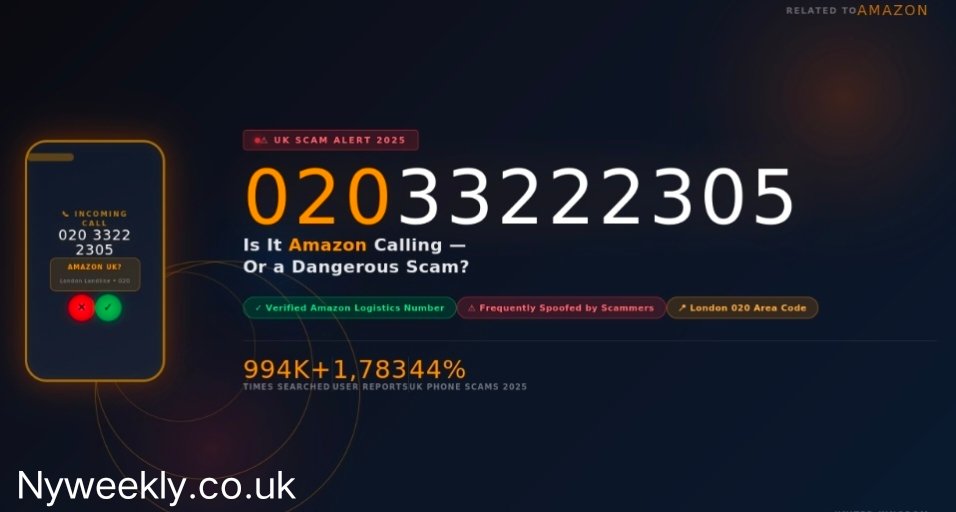
You are sitting at home waiting for a parcel. Your phone rings. The number on your screen reads 02033222305. Your first thought: is this Amazon? Your second thought: what if it is not?
That split-second moment of doubt has been felt by hundreds of thousands of people across the UK. In fact, this number has been searched online nearly one million times, with over 1,700 user comments left by confused, cautious, and sometimes defrauded people trying to figure out exactly who is on the other end of that call.
Here is the honest truth — this number is both legitimate and dangerous, depending on who is calling you. That sounds contradictory. Let me explain exactly why, and more importantly, how you can protect yourself every single time this number appears on your screen.
What Exactly Is 02033222305?
Let us start with the basics. The 020 prefix tells you this is a London-based landline number. In the UK telephone system, 020 numbers are associated with Greater London and are widely used by businesses, government bodies, and large organisations. That prefix automatically carries a level of trust — which is precisely why scammers love it.
READ MORE: Faccccccccccccc: What This Viral Internet Expression Really Means and Why It Is Everywhere
This specific number, 02033222305, has been widely confirmed by real users as a number used by Amazon Logistics — the delivery arm of Amazon UK. Multiple verified reports describe delivery drivers calling from this number to confirm drop-off locations, alert customers about missed deliveries, or check access details for gated properties and apartment buildings.
One user on Tellows.co.uk described a typical legitimate call: “Amazon delivery driver calling to confirm delivery drop-off.” Another wrote: “Delivery driver to say parcel at block of flats, no entry — good service.”
So yes, this can be a completely real, harmless call from an Amazon courier trying to deliver your package.
But here is where it gets complicated.
Why Is 02033222305 Also Reported as a Scam Number?
The same number that Amazon uses for legitimate deliveries has also been flagged repeatedly by users who received calls that were clearly not from Amazon.
One report stands out starkly. A user answered the call expecting an Amazon delivery update. The caller claimed to be from O2 — not Amazon — and immediately began asking for bank details to “upgrade their phone.” The user challenged the caller, and the response was: “Yes, I have your details. Just answer these questions and I will tell you EACH AND EVERYTHING” — a phrase widely associated with Indian call centre scam operations.
Amazon themselves have categorically confirmed to at least one user that 02033222305 is not an official Amazon customer service number. When that user contacted Amazon directly to verify, Amazon advised them to block the number entirely.
Understanding Phone Number Spoofing — The Technology Behind the Confusion
Spoofing is the single most important concept to understand about this number — and about phone scams in general.
Spoofing technology allows anyone, anywhere in the world, to make a call that appears on your screen to come from any number they choose. A fraudster sitting in another country can make your phone display 02033222305 even though the call has nothing to do with Amazon or London.
This is not a theoretical risk. Amazon’s own 2025 scam trend report confirms that phone-based scams in the UK accounted for 44% of all reported scams in 2025 — surpassing even email scams at 37%. That is the highest phone-scam rate of any country Amazon tracked globally. Scammers in the UK are specifically and aggressively targeting people through phone calls, and number spoofing is their primary weapon.
Amazon also took down more than 55,000 phishing websites and 12,000 phone numbers being used for impersonation scams in 2024 alone. The scale of this problem is enormous.
How to Tell if the Call from 02033222305 Is Genuine or a Scam
This is the section you actually came here for. Here is a clear, practical breakdown.
Signs the Call Is Probably Legitimate
- You placed an Amazon order recently and are expecting a delivery
- The caller identifies themselves as an Amazon delivery driver — not a customer service representative
- The caller asks only for directions, gate codes, or confirmation that you are home
- The call is brief and focused entirely on your delivery
- No personal or financial information is requested under any circumstances
- A photo of your delivered parcel appears shortly after in your Amazon app notifications
Signs the Call Is Almost Certainly a Scam
The following red flags — confirmed by Amazon themselves — should make you hang up immediately:
They ask for payment. Amazon will never ask you to make a bank transfer, share credit card details, or pay via gift cards over the phone. Ever. If anyone claiming to be Amazon asks for money over the phone, you are talking to a scammer.
They ask for your password. Amazon’s official guidance states clearly that they will never ask for your Amazon password, bank account number, or any sensitive personal information during a phone call.
They ask you to install an app. This is a remote access scam. Fraudsters trick victims into installing apps like AnyDesk or TeamViewer, then take control of their device and drain their bank accounts.
They ask you to share a One-Time Password (OTP). If you receive a text code and someone on the phone asks you to read it out — hang up. OTPs are your security barrier, and sharing one gives scammers direct access to your accounts.
They create urgency. Phrases like “your account will be suspended,” “you must act now,” or “your personal details have been compromised” are textbook pressure tactics. Real Amazon delivery drivers do not speak this way.
The call has nothing to do with any order you placed. If you have not recently ordered anything on Amazon and you receive a call from this number, treat it as suspicious by default.
Real Stories: What Happened When People Answered
The user community around this number tells some genuinely revealing stories.
One person in a security-gated estate received a call from this number at 9:15 PM from someone claiming to be an Amazon driver trying to deliver a package. The person had not ordered anything, and their building is inaccessible to drivers at that hour. Clear scam.
Another user received five or six text messages before the call — supposedly from the driver’s mobile number — followed by a call from 02033222305. When they contacted Amazon directly, Amazon confirmed both the texts and the number were spoofed.
On the other side, a user who missed a delivery twenty minutes before the call found their parcel safely left in their designated safe space. For them, the call was entirely genuine and the service was actually impressive.
The pattern is consistent: if the call connects directly to something happening with a real, recent Amazon order, it is likely genuine. If it appears out of nowhere with requests for information or payment, it is a scam.
What You Should Do Right Now If You Received This Call
Follow these steps in order, and do not skip any of them.
Step 1: Do not share anything. If you are still on the call and something feels wrong, hang up. Amazon’s own guidance says it plainly: it is okay to hang up. You owe scammers nothing — not politeness, not your time, not your information.
Step 2: Check your Amazon account directly. Open the Amazon app or go to amazon.co.uk and log in. Check your recent orders and delivery notifications. If a legitimate Amazon driver was trying to reach you, there will be evidence in your account — a delivery attempt, a message, or a photo. If there is nothing there, the call was not from Amazon.
Step 3: Contact Amazon through official channels only. If you have any concern about your account, contact Amazon through the app or website directly. Never call back a number that called you. Find Amazon’s contact details only through amazon.co.uk.
Step 4: Report the call. If you believe you received a scam call, forward details to reportascam@amazon.com. You can also report to Action Fraud UK (actionfraud.police.uk) or call 0300 123 2040. The UK Home Office also runs a campaign called Stop! Think Fraud at stopthinkfraud.campaign.gov.uk with additional resources.
Step 5: Block the number. Use your phone’s built-in blocking feature. Apps like Truecaller and Hiya are both excellent for identifying and blocking suspected spam numbers in the UK. Your mobile carrier may also offer free scam call filtering — check your account settings.
Step 6: If you shared information — act fast. Contact your bank immediately if you gave financial details. Change your Amazon password and enable two-factor authentication. Report to Action Fraud without delay.
The Bigger Picture: Amazon Impersonation Scams in 2025
This is not just about one phone number. The 02033222305 situation reflects a much larger and growing problem.
Amazon’s own data shows a 71% spike in phone-based scams between February and March 2025 alone. Scammers are actively switching from email to phone calls because phone calls are harder to filter automatically and easier to make convincing.
The two dominant phone scam tactics right now are account issue scams — where fraudsters claim there is a problem with your Amazon account, representing 82% of cases — and order-related scams, where they reference a fake purchase and ask you to confirm or cancel it, representing 16% of cases.
What makes 2025’s scams particularly dangerous is the use of AI-generated voices. Calls now sound more natural than ever, sometimes even using regional accents. Scammers also use data from previous breaches to address you by name or reference your past purchases, making the call feel shockingly personal and believable.
Truecaller, Hiya, and Nomorobo remain the most recommended call-blocking tools in the UK. Most major carriers also offer spam filtering at no extra cost — enabling this is one of the simplest protections you can put in place today.
READ MORE: adswynk com: Understanding Its Role in Online Advertising Platforms
Conclusion: Trust Your Instincts, Then Verify
The number 02033222305 sits in an uncomfortable grey zone — used by real Amazon delivery drivers, but also spoofed by sophisticated scammers targeting UK residents daily.
The rule is simple. If a call from this number connects clearly and directly to a real order you placed, and the caller only wants to know where to leave your parcel, you are probably fine. If anything else is happening — requests for information, pressure tactics, unexpected calls, or anything financial — treat it as a scam and end the call immediately.
Your instincts exist for a reason. When something feels wrong, trust that feeling. Then verify everything through Amazon’s official channels before taking any action whatsoever.
Phone scams are growing more sophisticated every month. The best defence is knowledge — and now you have it.
Frequently Asked Questions About 02033222305
Is 02033222305 an official Amazon number?
It is used by Amazon Logistics for delivery-related calls, but it is not an official Amazon customer service number. Amazon itself has told users it is not a number they should call back if they receive it unexpectedly.
Can scammers fake this number on my caller ID?
Yes. Spoofing technology allows fraudsters to make any number appear on your screen. Seeing 02033222305 on your caller ID does not guarantee the call is from Amazon.
What should I do if I already gave my bank details to a caller from this number?
Contact your bank immediately to freeze any at-risk accounts or cards. Then report the incident to Action Fraud at actionfraud.police.uk or call 0300 123 2040.
Will Amazon call me if I have not placed a recent order?
Almost certainly not for delivery purposes. If you receive a call from this number and have no recent orders, treat it as suspicious and do not engage.
What apps can help me identify and block this number?
Truecaller, Hiya, and Nomorobo are the most widely recommended options in the UK. Your mobile carrier may also offer built-in spam filtering at no extra cost.
How do I report a scam call to Amazon?
Forward details of any suspicious communication to reportascam@amazon.com. Amazon uses these reports to identify and take action against bad actors.
READ MORE: https://nyweekly.co.uk/